Essays/linkedin/26-02-25 wet chemistry
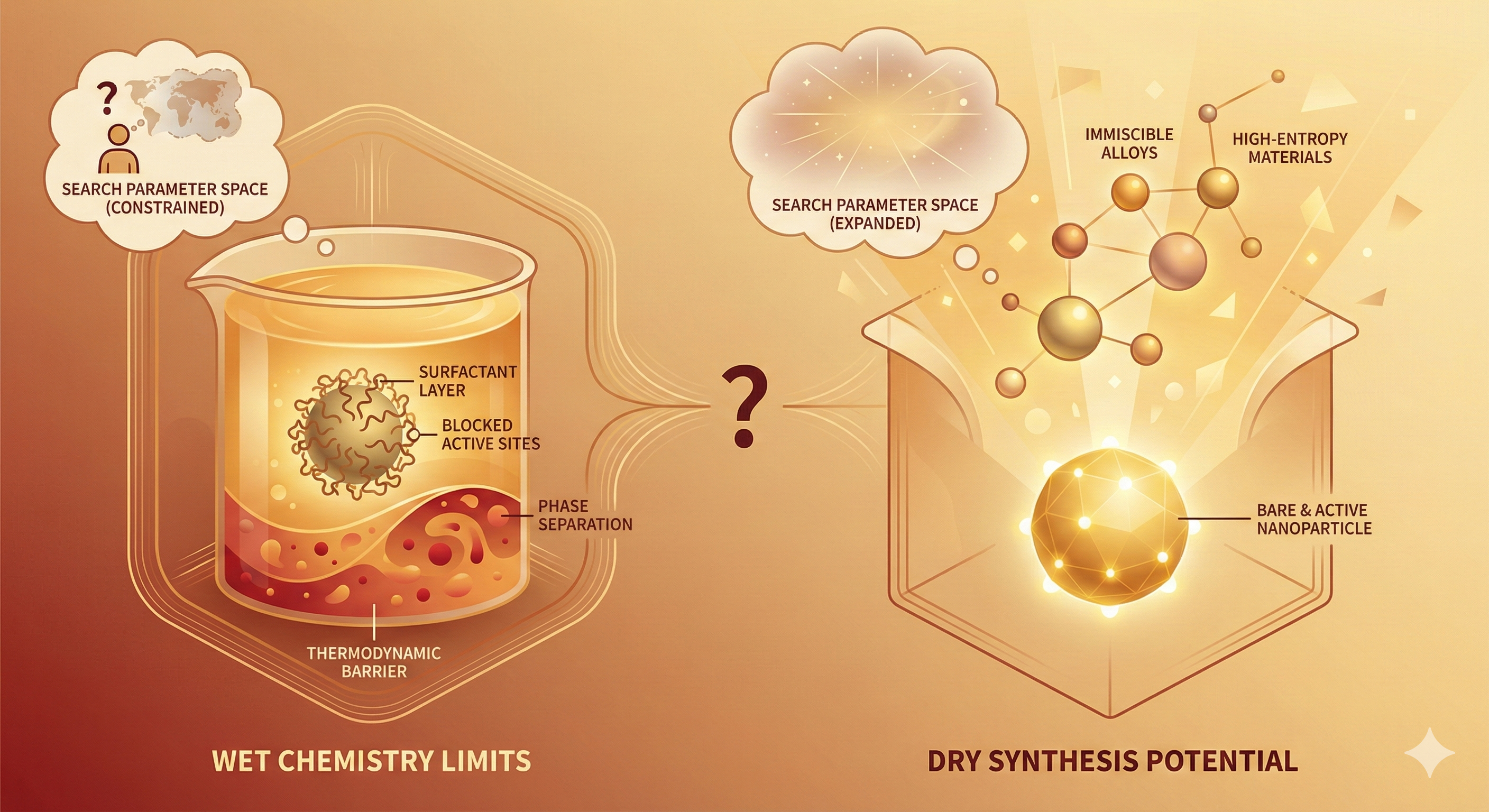
Can wet chemistry be the limiting factor to the space parameter in which we search for new materials?
I always associated synthesis with a liquid-based approach. My first approach was trying to crystallize compounds by careful evaporation, then I got into making gold nanoparticles in a beaker. But I never stopped to think whether a liquid-based approach is the driving force in limiting the materials we can create.
For example, when making nanoparticles, it is impossible to use a surfactant. Without it, particles would just aggregate.
But surfactants cover active sites and become "something to deal with" at a later stage, if possible at all (something I learned the hard way when using PEGylated gold particles).
But then, there are the thermodynamic considerations as well.
Not all alloys (especially when thinking about high-entropy ones) can be synthesized in a beaker, regardless of the number of DFT simulations you run telling you how valuable they would be.
We chemistry has the advantage of counting with a massive toolset for automation, and many roads for scalability. Getting started is normally very low cost, and labs can build complexity as required.
With its own merits, maybe it is time to start thinking outside the box imposed by the wet-chemistry approach.
Have you already considered dry synthesis methods? What are your biggest hurdles when thinking on how to incorporate them to your pipeline?
Backlinks
These are the other notes that link to this one.
Comment