Literature/202211031710 characterization of physicochemical properties of nano vaccines
- Source: [@guerrini2022Characterization of nanoparticles-based vaccines for COVID-19]
- Tags: #Vaccine #COVID #nanomedicine
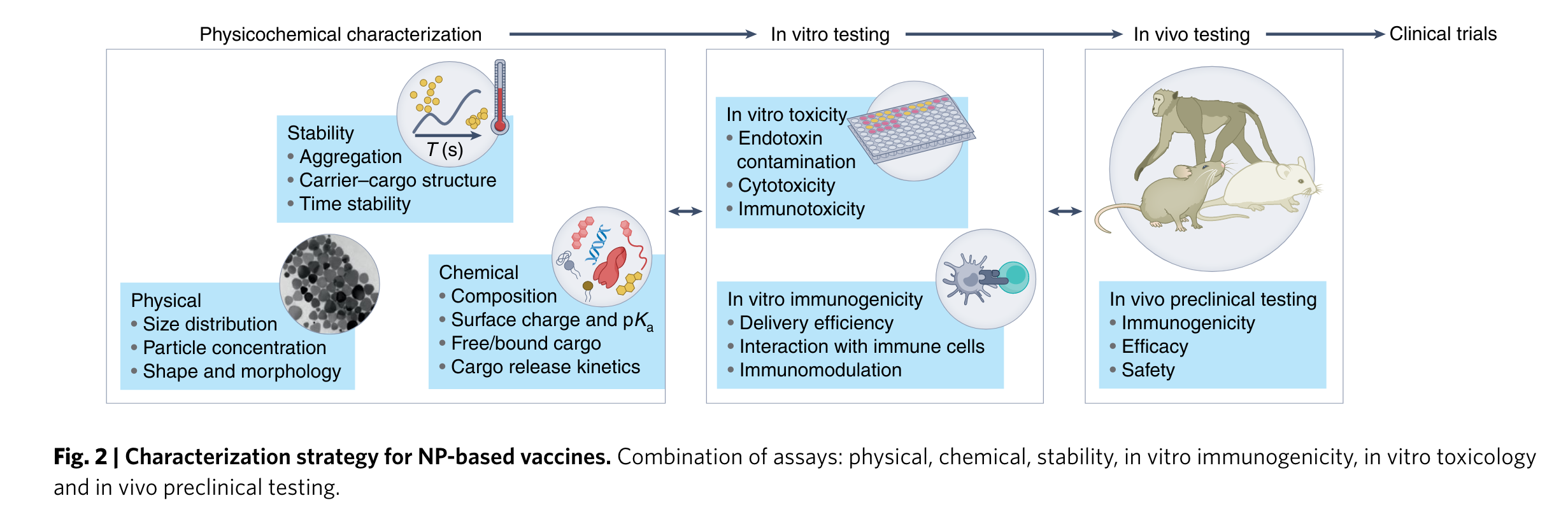
Nanoparticles are crucial tools for the delivery of active substances in nano-vaccines, such as those developed by Moderna for COVID19. However, there are many open questions when it comes to how to characterize them to ensure their safety and efficacy.
To avoid costly setbacks, researchers should incorporate early in the design and development of NVs an adequate characterization strategy that utilizes multiple techniques, such as to combine orthogonal measurements an interdisciplinary expertise. The first EMA report on the BNT162bs mRNA vaccine [...] highlighted the need for additional analysis of the capped-intact RNA measurement, truncated and/or modified mRNA species fate, translated protein characterization, assessment of lipid0related impurities and biological characterization.
There is an initiative called MIRIBEL (Minimum Information Reporting in Bio-Nano Experimental LIterature) (not too disimilar to what is propsed with MISEV guidelines) in order to standardize the reporting to enable intra-lab comparisons.
For physical characterization, dynamic light scattering is proposed as an ubiquitous tool that fails with polydisperse samples. Of course, A4F is pushed as a valuable alternative. Other techniques mentioned are NTA, TRPS, and Analytical Ultracentrifugation. The gold standard for imaging is still the electron microscope.
Chemical characterization is done with High Performance Liquid Chromatography, perhaps coupled with mass spectrometry. One of the most challenges aspects is to characterise the active substance that is loaded into the particles.
Backlinks
These are the other notes that link to this one.
Comment