202504291345
- Source: [@potyrailo2020Extraordinary performance of semiconducting metal oxide gas sensors using dielectric excitation]
- Tags: #gas-sensor #detection #MOX
In order to overcome the Limitations of chemiresistive gas sensors, instead of measuring the resistance, the authors propose to measure the impedance of the sensitive layer.
It is important to keep in mind that there's a fenomenological power-law rule regarding the resistivity of the sensing layer:
$$ R = R_0(1 + K_\textrm{gas}[\textrm{gas}])^{-\beta} $$ Where $K_{\textrm{gas}}$ is the sensitivity to a specific gas, while $\beta$ depends on different factors, such as:
- The nature of the measured gas
- The type of sensing material, including the grain size, grain surface-to-volume ratio, types of dopants
- The geometry and material of the electrodes of the sensing element.
Using the following circuit diagram for the sensing measurement (IC: intergranular contacts, EC: electrode/particle contacts)
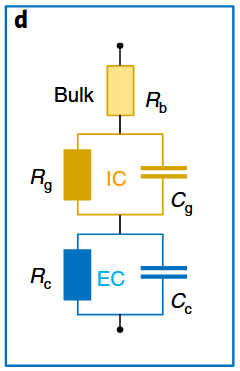
We can define (not sure where this is coming from):
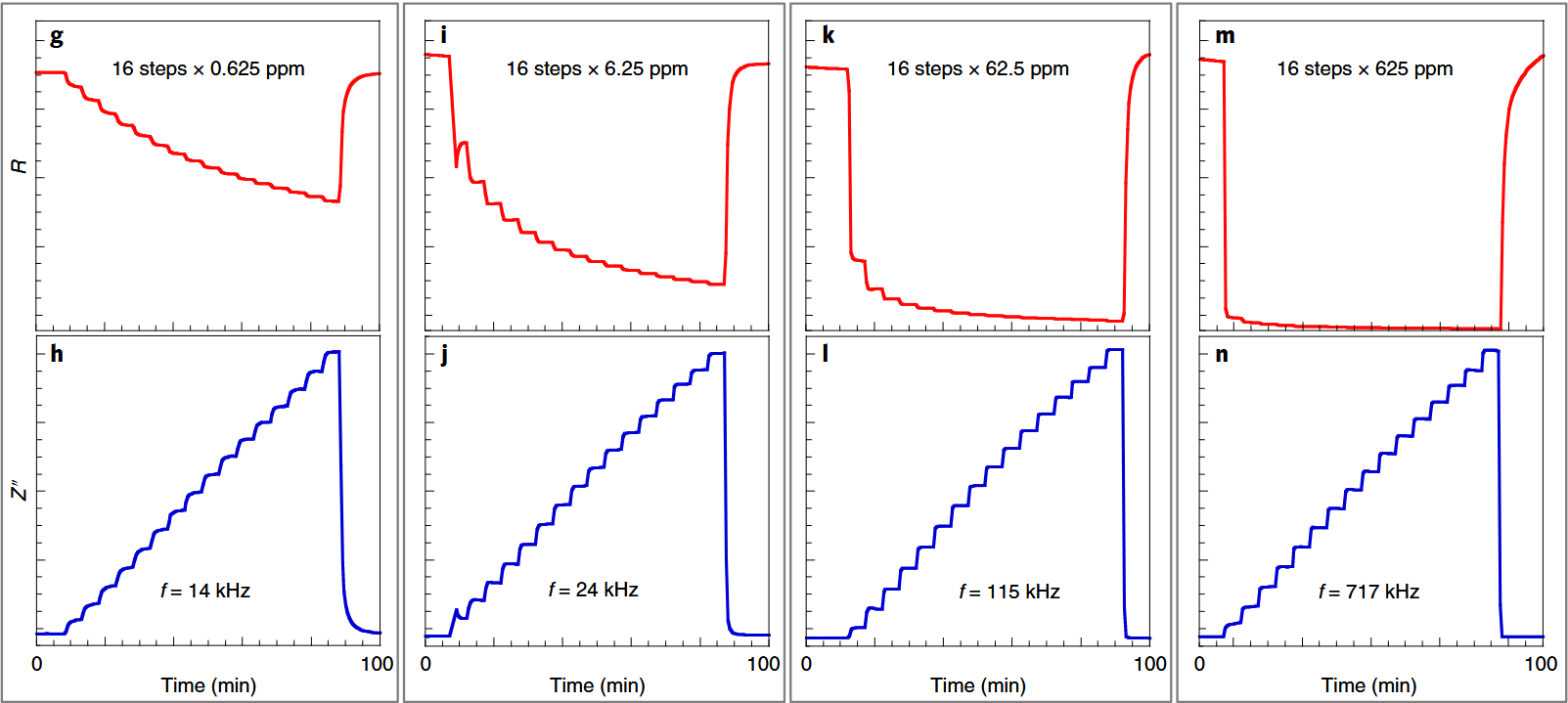
$$ Z' = \frac{R}{1+(2\pi fCR)^2} $$ $$ Z'' = \frac{-R^2C2\pi f}{1+(2\pi fCR)^2} $$ The entire observation of the paper is that while resistance alone has a non-linear behaviour and saturates at relatively low concentrations of gas, $Z''$ shows a linear behavior in a wide range of parameters.
Interesting to remember:
- The sensor used was TGS 2611
- ASIC: AD5933, ADuCM355
Backlinks
These are the other notes that link to this one.
Comment