Scrum for hardware explained - paolo sammicheli
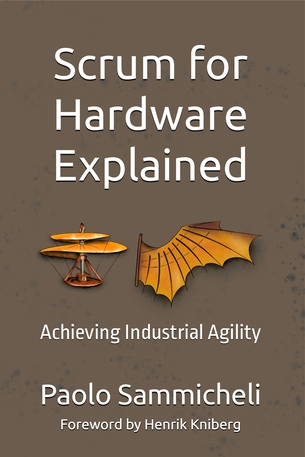
This book is less focused than what I expected. It is fundamentally a broad overview of Scrum development (very aligned with Scrum - Jeff Sutherland, after all the author is a Scrum trainer). It gives hints to other frameworks that may be relevant, but the examples are quite superficial to make them relatable.
There's also a bit of a guide on how to create change in an organization, how to bring up Scrum, starting with a small pioneer team, etc. These are all valid ideas, but I missed the extra step, how to handle problems (not just "interruptions"). There's an idealized vision that makes it a bit detached from reality. There's no measure of impact, for example.
How do we know things are better after we have implemented all the overhead that Scrum requires?
Agile
 It starts with an intro to agile methodologies (agile development) but not specifically focusing on hardware nor related. It is a refresher of what agile means.
Scrum
The same is true for Scrum. The introduction is fundamentally the same that can be found anywhere else, without much insight into what it means for hardware teams.
The fact that it's a generic piece of advice makes it harder to read and collect useful ideal to try to implement.
However, there are interesting ideas that are worth keeping in mind:
-
Value Stream Map How does the entire value chain of the organization works: from receiving an RFQ to the delivery, payment, and after support. Once the stream is clear, we can proceed to identify waste, eliminate it, and gain efficiency.
-
Skill Mapping Every step of the stream must be paired with different skillsets, that allows to identify missing profiles.
-
Separating Roles from Profiles A role is a "Mechanical Designer" while a profile is "Mechanical Design". A professional can have several profiles even if only one role.
Implementing Scrum in Business
There is a bulk of information on how to implement the approach in a business context. From creating buy-in from management, to selecting a winning strategy.
For example, in the mapped value stream, the best idea would be to focus on one improvement that can be achieved with a team of fewer than 10 people. Larger teams are not as effective and would require "scrum of scrums" to work it out.
Backlog
When transitioning into Scrum methodology, there is a chance that the team has another type of working agreement. For example, it could be a waterfall approach with stage-gates. (stage gate).
The backlog therefore is composed of all the deliverables that the project must provide in order to be deemed "done".
The biggest difference is that by listing deliverables, teams can find the best way of working instead of having a top-down approach to what needs to be done.
In agile: "People and interactions over processes and tools".
7 Dimensions
Customer Discovery can benefit from analyzing the situation using 7 dimensions:
-
User What are the users that are going to interact with the product? Background? 202303251644 Jobs to be done framework
-
Interface What interfaces connect the users with the system?
-
Action What actions are required from the users to provide the needed capabilities? Workflow, how does the product respond?
-
Data What source of data will be involved to provide the capability?
-
Control What are the controls we need to perform? Risks if the product does not comply?
-
Environment The physical properties and technological platforms involved?
-
Quality Attribute Functionality, Usability, Reliability, Performance, Security, etc.
Backlinks
These are the other notes that link to this one.
Comment