The abundance of tetraspanins in evs can be linked to the sample preparation protocol
Tetraspanins are used as markers for EV's, although it is known that Tetraspanins are unevenly distributed across extracellular vesicles.
Moreover, the abundance of tetraspanins may change depending on the centrifugation protocol used for isolating the particles[@martinjaular2021Unbiased proteomic profiling of host cell extracellular vesicle composition and dynamics upon HIV-1 infection], as can be seen in the image below.
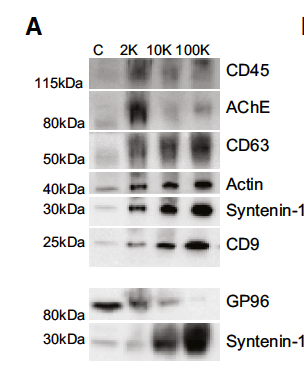
What I find most intriguing is that CD45 and AChE are distinctively found in 2K spins, but not in 10K and 100K. It is not clear to me whether this means that the specific proteins do not appear in the pellets generated at higher speeds or that their relative abundance changes.
I wonder whether Western blot analysis is of a real use, and what would be a limiting factor to actually use it as a quantifiable measure instead of a purely qualitative measure as it seems is being used.
Backlinks
These are the other notes that link to this one.
Comment