Exoview
Is the name of the product from NanoView Biosciences that implements the SP-IRIS method. The image below [@mizenko2021Tetraspanins are unevenly distributed across single extracellular vesicles and bias sensitivity to multiplexed cancer biomarkers] shows an example of how the device can be used.
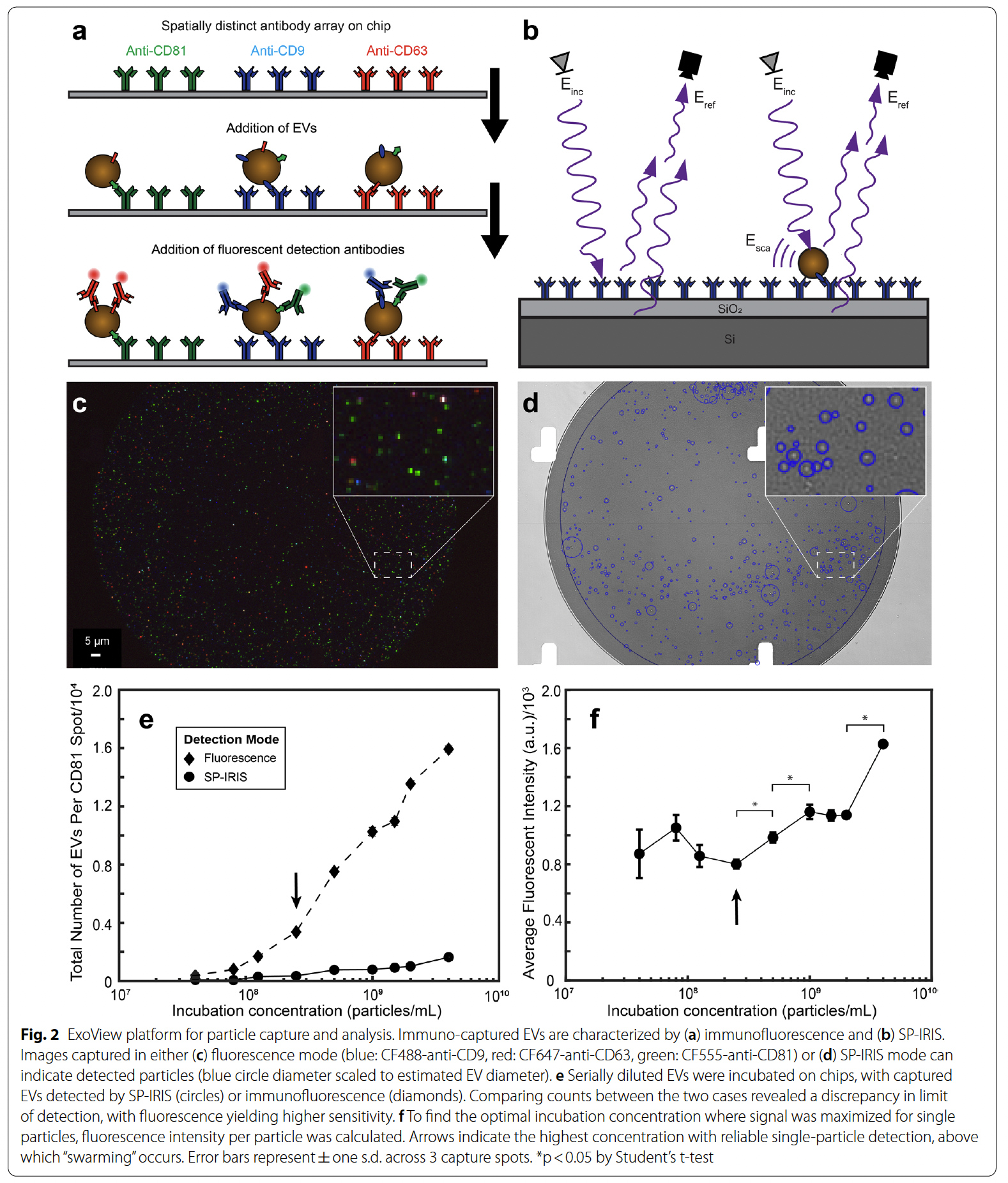
The interesting thing is that it implements interferometric detection (very similar to iSCAT) and fluorescence detection. Therefore it allows to quantify both labeled and unlabeled objects. Particularly, the chips used seem to be able to contain different antibodies, and therefore they allow to perform single-particle Elisa test using different proteins in one go.
According to [@mizenko2021Tetraspanins are unevenly distributed across single extracellular vesicles and bias sensitivity to multiplexed cancer biomarkers], the detection limit for the scattering method is $50\,nm$ for EV's given some phenomenological constrains, but in theory the method (iSCAT) can be pushed for single-molecule detection.
This is a clear example of how easy it is for a company, like Refeyn, to Miss out opportunities because of internal culture.
Backlinks
These are the other notes that link to this one.
Comment